Wednesday, July 1, 2015

Week 8 Reflection

Reflect on the idea that tests are the only objective assessments of student learning.

According to Merriam-Webster, a test is a critical examination, observation, or evaluation. But when my students ask if we are having a test or a quiz they don’t want me to respond that any assessment fits the definition of a test. However, it is important to acknowledge that projects, essays, portfolios, and the like all test a student’s understanding and ability to apply skills in different ways.
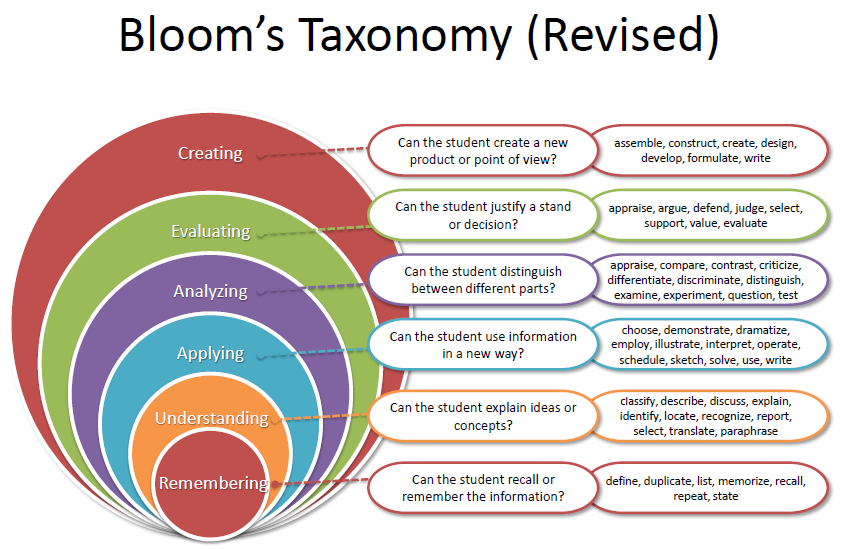
I think most people take the word test in an academic sense to mean a series of related questions that must be answered correctly.  The type of questions asked can affect how objective or subjective the overall test is.  Standardized test with hundreds of multiple choice questions are objective. By integrating open-ended questions, with analytical and interpretive answers, adds subjectivity. I believe that this ties directly to assessing higher levels of Bloom’s taxonomy which do always manifest themselves in objective ways.  


References:

Test. 2015. In Merriam-Wester.com. Retrieved July 1, 2015 from http://www.merriam-webster.com/dictionary/test

Tuesday, June 16, 2015

Week 6 Reflection

Reflect on the idea of what a technology-infused classroom looks like. How do you plan to have a technology-infused classroom?

I honestly believe that the classroom has always been a technology-infused environment.  When the graphite pencil replaced clay tablets, that was the cutting edge educational technology of the time.  Forty-five years ago as the pocket calculator pushed the slide-rule into obscurity, it was the most innovative technology there was. Now in the era of interactive whiteboards, eBooks, meta-search engines, and cloud-based collaborative work spaces these tools are being field tested in today’s most modern classrooms.  These tools then become commonplace to modern students so that they can grow to develop new technologies for the next generation of learners.  After all, if that is not the most fundamental reason for a classroom to exist then I don’t understand the purpose.

So what does a technology-infused classroom look like? Well, once it was a teacher taking a moment to explain that some of the calculators were powered by the Sun’s energy.  Another time, it was a teacher struggling to figure out why the VHS tape would not play.  Today, it is teachers examining and instructing with computers, tablets, 3D printers, and virtual reality. Today’s teachers too have difficulties and sidebars amongst moments of immeasurable success. The moments of failure, when the software crashes, are essential because it means that teachers are trying. It is easy for someone to rely on only the tools that have been successful in the past, trying something new is a challenge that must be embraced.

In my technology-infused classroom, each student has a calculator that is more powerful than the computer that I brought to college.  It only takes seconds for a student to use a laptop or smartphone to research a fact or formula from the internet. Simulation and drafting software allow students to explore relationships with unprecedented accuracy and efficiency.  Students work out solutions on tablets, send them to the cloud, and display them on the interactive whiteboard for others to evaluate. All the while, I’m trying to explain how I saw some cool website that lets us take online quizzes and how we will use it in an upcoming class.  And some days it just doesn’t work, and I spend a few minutes explaining what a slide-rule is, and how it calculated all of the math that put the first man on the moon.  Because sometimes even the obsolete technology is important too.

In case you were wondering here is a few minutes on what a slide-rule is: https://www.youtube.com/watch?v=waiprjueVpQ


This video show some amazing applications of the more modern technology called augmented reality: https://www.youtube.com/watch?v=uHIxYpBW7sc

Monday, June 1, 2015

Week 4 Reflection

How can visual literacy and the use of the Internet impact the teaching and learning process in the classroom? What are some visual-thinking strategies you would like to use in your classroom? What role do you want the Internet play in your classroom?

Visual Literacy

“A picture is worth one thousand words”

Visual literacy is the ability to interpret meaning from images and create images that convey meaning. When a teacher can use images effectively and appropriately they can convey more information and emotion than they could through spoken work or written text. Student must be trained how analyze pictures and graphics and a level of meta-cognition is needed before they can reliably create their own images to convey the desired meaning.  One way that the internet could be used to support such a teaching and learning style would be allowing students to (safely) search for images related to a specific theme or event and then discuss how images portray information about it. Alternatively, students could use communication forums such as blogs to discuss what they get from a particular image.

I would like to see the internet become as integral and incorporated element in the classroom as the textbook and notebook. The internet has become a reference and research tool, a means of communion, and a collaborative work space.  The application of the internet and visual literacy are expanding rapidly.   

Tuesday, May 19, 2015

Week 2 Reflection:


Describe the importance of the using a variety of instructional strategies and the value they add to education of students in the 21st century. Evaluate the role technology plays in the implementation of various instructional strategies. How will this affect your teaching of students?


The learning styles of our students is both diverse and dynamic.  As such, the methods used in instruction must also be varied, to accommodate their needs.  Moreover, different types of content and levels of understanding lend themselves more or less effectively to specific instructional techniques. At times it is essential to deliver information to the entire class and thus a teacher-centered approach such as direct instruction is employed.  More frequently, it is essential that students have the opportunity to interact with the content and practice new skills and therefore a student-centered approach must be utilized. In either instance, the integration of technology can often enhance the learning experience.  A multimedia presentation can be more effective than a chalk-and-talk lecture when it comes to direct instruction.  An activity such as a web-quest can allow students to interact with the content in broad reaching ways that might otherwise be restricted by the classroom itself.


What these concepts have taught me about teaching is, that much like the students learning styles, my teaching styles must be diverse and dynamic. There is no one way to teach all content. An effective educator evaluates the needs and abilities of the students and the curriculum and caters the instruction accordingly.